


Turning Organic Waste into Clean Energy: The BIO3 Biogas Solution
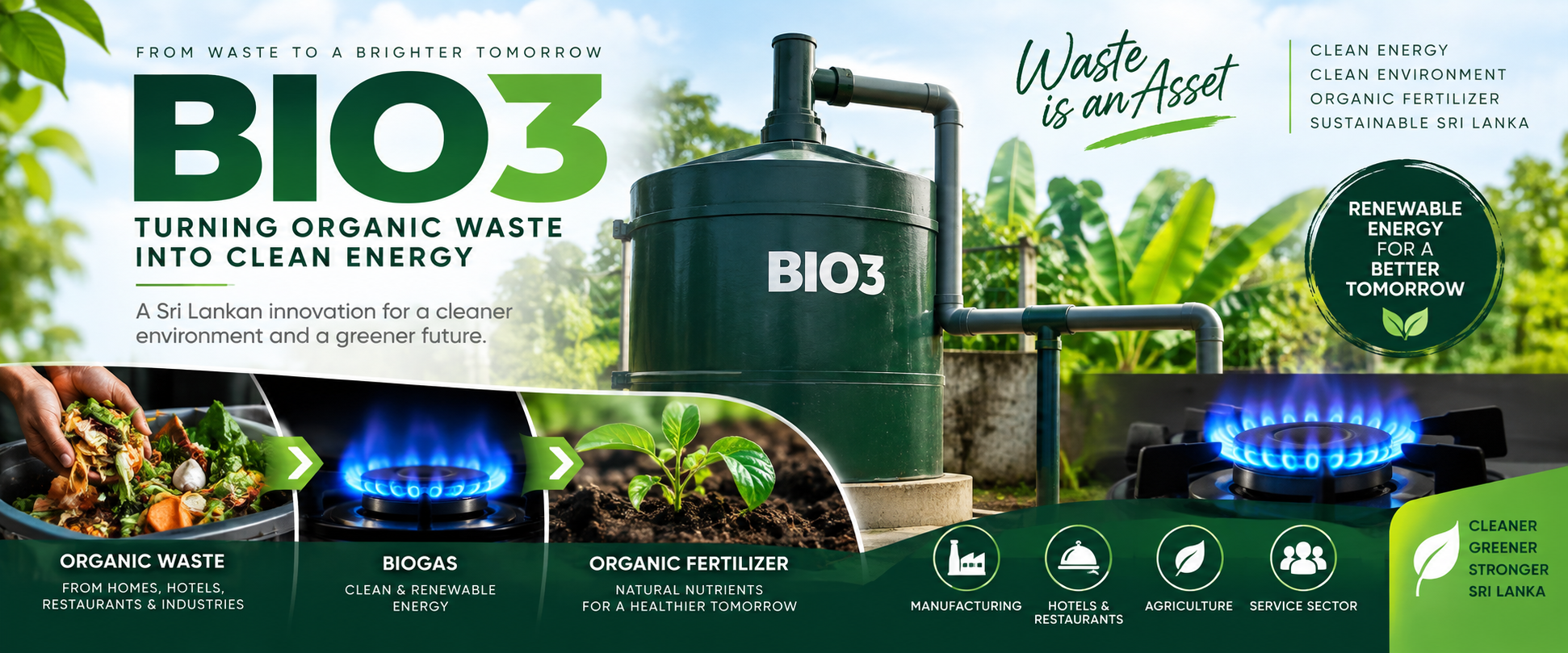
Every day, homes, hotels, restaurants, farms, and industries generate large quantities of organic waste. Instead of treating this waste simply as something to dispose of, the BIO3 Biogas System offers a practical approach: turn organic waste into a useful source of renewable energy and organic fertilizer.
Developed for Sri Lankan conditions, the BIO3 concept combines waste management, clean-energy generation, and agricultural benefits in one compact solution.
A Sri Lankan Innovation for Sustainable Energy
The BIO3 concept was developed by Sri Lankan scientist Srimal Tissera, drawing inspiration from biogas methods used in countries such as Germany, India, and Sweden.
According to the product information, Mr. Tissera obtained a patent for the system and received recognition in the field of Public Welfare at the Presidential Awards in 2010 for his compact biogas plant innovation.
The concept has a straightforward vision: use locally available organic waste to generate clean fuel while producing valuable organic fertilizer.
How Does the BIO3 Biogas System Work?
The system uses a digestion tank where organic waste is broken down through a natural fermentation process.
Organic kitchen waste is mixed with water and fed into the inlet of the digestion unit, typically twice a day. As the organic material decomposes, biogas is generated and collected in the upper section of the tank.
As gas accumulates, the upper unit rises. A gas tube connected to the outlet then allows the generated gas to be channelled for practical use.
At the same time, the outlet of the digestion unit releases liquid organic compost/manure, providing an additional benefit from the waste-treatment process.
Depending on the size of the tank and the amount and type of feedstock used, the BIO3 system is designed to provide a useful daily supply of biogas.
What Can Be Used as Raw Material?
The system is designed to process several types of organic material, including:
- Food and kitchen waste
- Green waste
- Water hyacinth
- Fats and oils
- Paper pulp
- Hotel food and oil waste
This makes the concept particularly relevant to locations that continuously generate biodegradable waste.
Applications Across Different Sectors
Manufacturing: Industries generating significant quantities of organic or domestic-type waste can potentially convert part of that waste into an energy resource rather than treating all of it purely as a disposal problem.
Hotels, Restaurants & Service Businesses: Hospitality and food-service operations can benefit from converting kitchen and food waste into biogas, potentially helping reduce waste-management requirements while providing an additional energy source.
Agriculture: The digestion process produces organic output that can be used for agricultural purposes, creating value from material that would otherwise be discarded.
Available System Capacities
The information provided highlights 500L, 1000L and 5000L systems, allowing the solution to serve different levels of waste generation.
For 500L and 1000L systems, the stated fabrication and installation period is approximately two weeks. For a 5000L system, the stated fabrication and installation period is approximately three months.
Orders are placed with a 50% advance payment. For 500L and 1000L units, the remaining balance is payable after installation. For the 5000L unit, the remaining 50% is divided into two stages: 25% at installation and 25% one month after installation.
Waste Is Not Always Waste
One of the strongest ideas behind BIO3 is simple: organic waste can be treated as an asset.
Instead of allowing food and other biodegradable waste to become an environmental and disposal burden, biogas technology provides an opportunity to convert it into usable energy while recovering nutrients as organic fertilizer.
For Sri Lankan households, agriculture, hospitality businesses, institutions, and industries seeking more sustainable waste-management solutions, systems such as BIO3 demonstrate how waste management, renewable energy and circular-economy principles can work together.
