

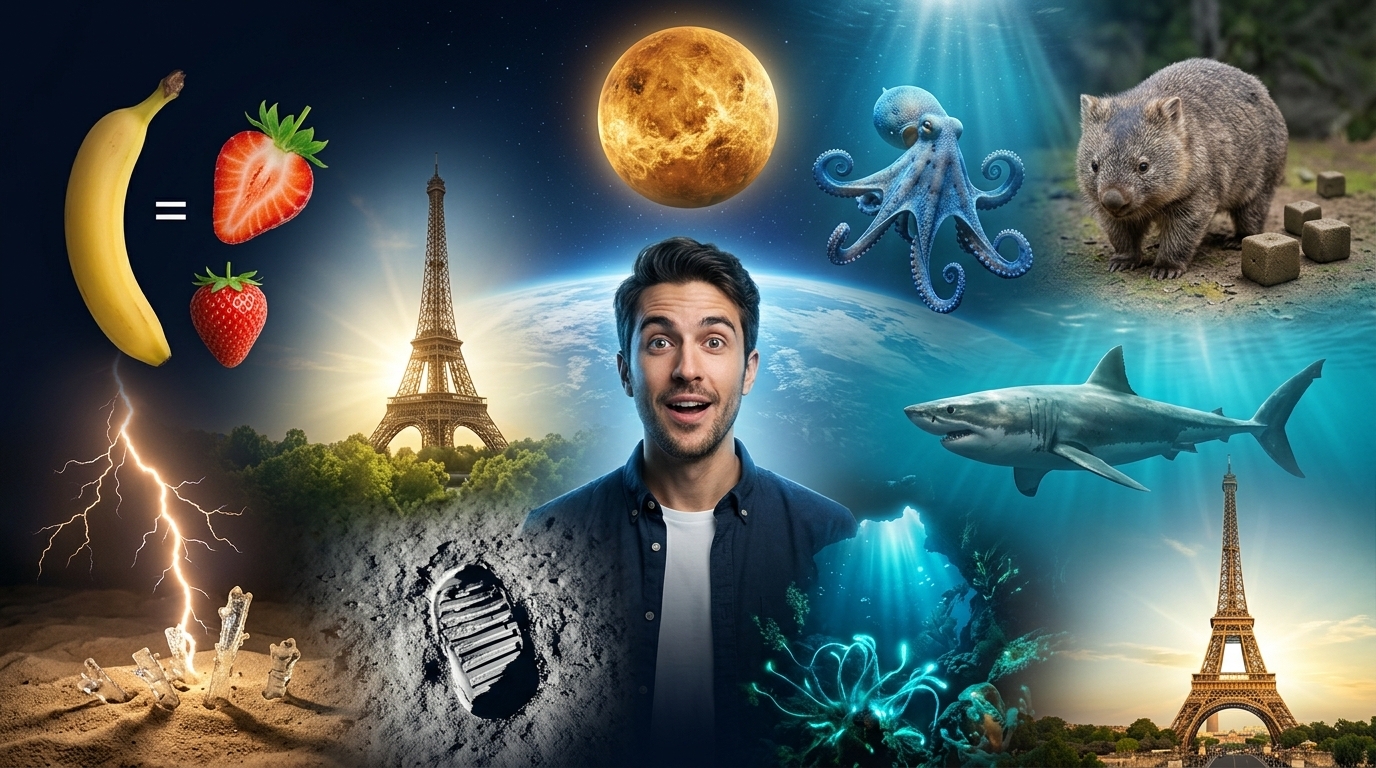
20 Random Facts That Sound Fake but Are True — Reality Is Stranger Than Fiction

Have you ever heard a fact so ridiculous that your first reaction was, “There’s absolutely no way that’s true”?
That is exactly what makes these facts fascinating.
From animals with three hearts to planets where a day lasts longer than a year, the real world is full of details that sound like internet myths—but are backed by science, history, and observation.
Here are 20 facts that might make you stop reading and immediately say, “Wait… what?”
1. A Day on Venus Is Longer Than a Year
Venus takes about 243 Earth days to rotate once, but only about 225 Earth days to orbit the Sun.
So, technically, one Venusian day is longer than one Venusian year.
Even stranger: Venus rotates in the opposite direction to most planets, meaning the Sun would appear to rise in the west and set in the east.
2. Wombats Poop Cubes
Yes—cubes.
Wombats are famous for producing cube-shaped droppings. The unusual shape is formed inside their intestines because different sections of the intestinal wall have different elasticity.
It may also be useful for territorial marking because cube-shaped droppings are less likely to roll away when placed on rocks or logs.
Nature clearly has some unusual engineering solutions.
3. Octopuses Have Three Hearts
An octopus doesn't have one heart.
It has three.
Two pump blood toward the gills, while the third circulates oxygen-rich blood around the body.
And their blood is blue because they use a copper-containing protein called hemocyanin to transport oxygen.
4. Sharks Are Older Than Dinosaurs
Shark ancestors were swimming in Earth's oceans more than 400 million years ago.
Dinosaurs appeared much later.
That means sharks survived enormous changes in Earth's environment and multiple mass extinctions while continuing to evolve into the diverse group we know today.
5. Lightning Can Be Hotter Than the Sun's Surface
A lightning channel can heat the surrounding air to around 30,000°C.
That's several times hotter than the surface of the Sun.
The rapid heating and expansion of air is what produces the shock wave we hear as thunder.
6. Astronaut Footprints Can Last for Millions of Years
On Earth, wind, rain, water and biological activity constantly reshape the surface.
The Moon has no atmosphere, rain or ordinary weather.
That means the footprints left by astronauts can remain preserved for an extraordinarily long time—potentially millions of years, unless disturbed by impacts or other processes.
7. Some Ocean Animals Make Their Own Light
Bioluminescence is real—and it is surprisingly common in the ocean.
Many marine organisms can produce light through chemical reactions inside their bodies.
In the deep ocean, where sunlight barely reaches, this living light can help animals find food, attract mates or confuse predators.
The deep sea can literally glow.
8. Sound Cannot Travel Through a Vacuum
Movies often show explosions in space accompanied by enormous explosions of sound.
Real space doesn't work that way.
Sound needs a medium such as air, water or another material to carry vibrations. The near-vacuum of outer space doesn't provide the environment required for ordinary sound waves to travel.
So an explosion in open space would be visually spectacular—but essentially silent to a nearby observer outside a spacecraft.
9. Bananas Are Botanically Berries
This one feels like a trick.
In botanical terms, bananas qualify as berries because of how their fruit develops.
Meanwhile, strawberries aren't considered true botanical berries.
The everyday meaning of a word and its scientific definition don't always match.
10. Venus Is the Hottest Planet, Not Mercury
Mercury is closer to the Sun.
So you might expect Mercury to be the hottest planet.
But Venus wins.
Its extremely thick, carbon-dioxide-rich atmosphere creates a powerful greenhouse effect that traps heat, making Venus hotter overall than Mercury.
11. Clouds Can Weigh Hundreds of Thousands of Kilograms
A cloud looks light because it floats effortlessly across the sky.
But a typical large cloud can contain an enormous amount of water.
The individual droplets are tiny and spread through a huge volume of air, allowing the cloud to remain suspended. Add them together, however, and the total mass can become surprisingly large.
Something that looks weightless can actually contain a tremendous amount of water.
12. The Eiffel Tower Changes Height
The Eiffel Tower isn't exactly the same height throughout the year.
Like many materials, iron expands when heated and contracts when cooled.
During hot weather, thermal expansion can make the tower slightly taller.
So the Eiffel Tower essentially gets a tiny seasonal growth spurt.
13. There Are Fish That Can Produce Electricity
Electric fish aren't science fiction.
Species such as electric eels can generate electrical discharges using specialized organs.
These electrical abilities can be used for hunting, defense and sensing their surroundings.
In other words, evolution created animals with their own biological electrical systems.
14. Some Turtles Can Breathe Through Their Rear End
Certain turtle species can absorb oxygen through highly vascularized tissues near the rear of their bodies.
This adaptation can help them remain underwater for long periods, particularly during cold conditions when their metabolism slows.
It's one of those biological facts that sounds like a joke until you learn the science behind it.
15. A Lightning Strike Can Turn Sand Into Glass
When lightning strikes sandy ground, its extreme heat can melt the sand.
The result can be a branching, glassy structure called fulgurite.
So lightning doesn't just illuminate the ground—it can literally reshape minerals into glass.
16. The Deep Ocean Has Its Own Light Show
The deeper you travel into the ocean, the less sunlight remains.
Red wavelengths disappear relatively quickly, while blue light penetrates farther.
That's one reason many deep-sea organisms and bioluminescent displays appear blue.
The ocean isn't simply dark—it has its own strange lighting system.
17. Some Jellyfish Can Reverse Their Life Cycle
One particularly unusual jellyfish, Turritopsis dohrnii, has attracted scientific attention because it can revert from its adult stage back toward an earlier developmental stage under certain conditions.
This doesn't mean it is literally immortal in every situation.
It can still be eaten, infected or killed by environmental conditions.
But its unusual ability to reverse its development is one of the strangest examples of biological flexibility known.
18. The Earth's Name Is Different From the Other Planets
Most planets in our solar system have names derived from figures in Greek or Roman mythology.
Earth is different.
Its English name comes from older Germanic and Old English words associated with ground or soil.
So while Mars, Venus and Jupiter sound like mythological characters, “Earth” essentially means the ground beneath our feet.
19. Sharks Don't Have Bones Like Humans Do
Shark skeletons are primarily made of cartilage, the flexible tissue also found in parts of the human body such as the nose and ears.
This is one reason shark fossils are often represented by teeth and other harder structures rather than complete bony skeletons.
Their lack of a traditional bony skeleton doesn't make them primitive—their lineage has been remarkably successful.
20. Reality Is Often Stranger Than Fiction
Perhaps the strangest fact of all is that the universe doesn't have to make sense according to human intuition.
A planet can have a day longer than its year.
An animal can have three hearts.
Lightning can become hotter than the Sun's surface.
A tiny marine creature can produce its own light.
And a wombat can produce cubes.
The lesson isn't simply to collect unusual trivia.
It's to stay curious.
When something sounds impossible, don't immediately believe it—and don't immediately dismiss it either.
Ask why. Check the evidence. Find out how it works.
Because sometimes the truth isn't boring at all.
Sometimes, the truth is the most unbelievable story you will hear today.
