
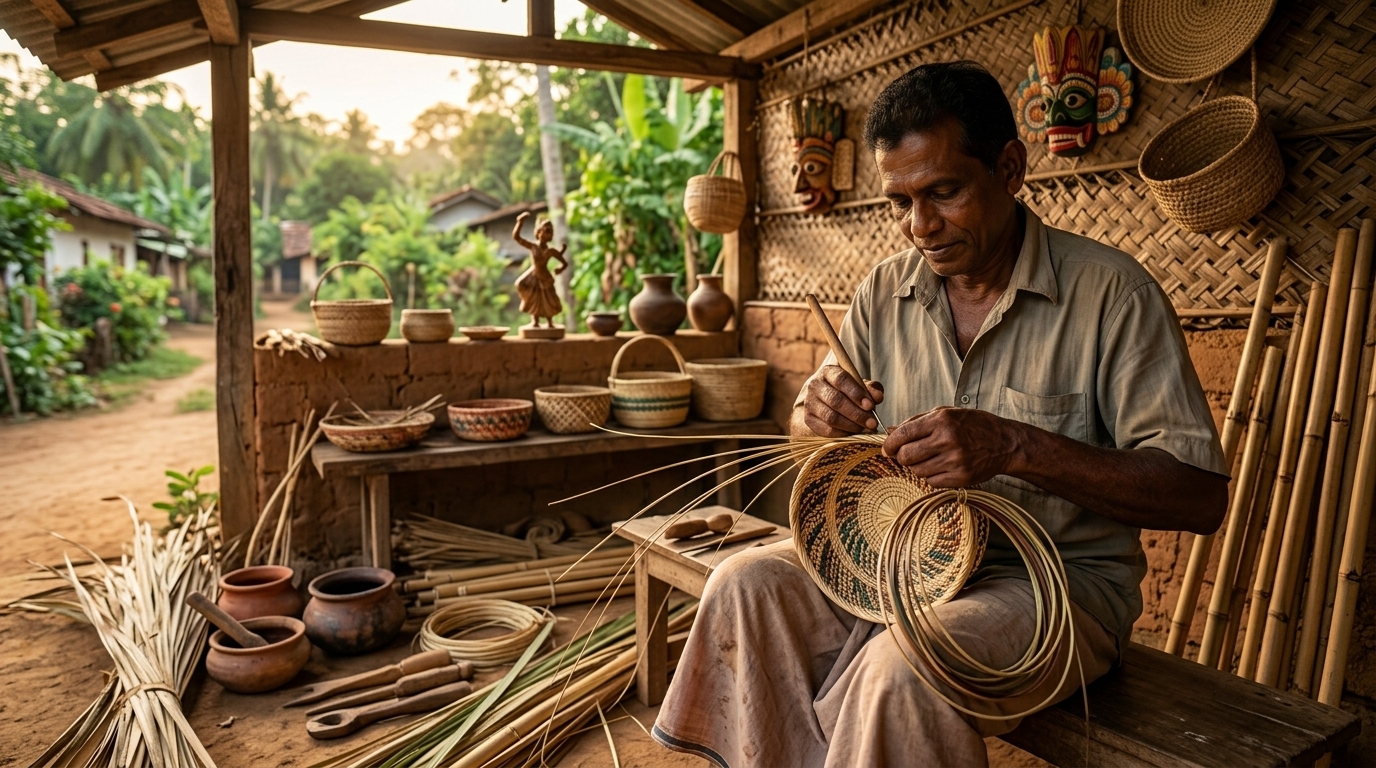
From Palm Leaves to Masterpieces: How Rural Sri Lankan Artisans Turn Simple Materials Into Art
Sri Lanka · Devinda Isuru · 06 Sep 2026
<p class="isSelectedEnd">What if some of the most beautiful things in Sri Lanka aren't made in expensive studios—but in small village workshops using materials that most people would overlook?</p>
<p class="isSelectedEnd">A strip of palm leaf.</p>
<p class="isSelectedEnd">A piece of clay.</p>
<p class="isSelectedEnd">A block of wood.</p>
<p class="isSelectedEnd">A handful of natural fibre.</p>
<p class="isSelectedEnd">In the hands of a skilled artisan, these ordinary materials can become baskets, masks, sculptures, jewellery, household objects and decorative pieces that carry generations of knowledge.</p>
<p class="isSelectedEnd">Sri Lanka's traditional crafts are not simply souvenirs. They are part of the island's cultural heritage—and behind every handmade object is a combination of patience, technique, local materials and creativity.</p>
<h3>The Art Begins With What Nature Provides</h3>
<p class="isSelectedEnd">For generations, rural artisans have worked with materials available in their surroundings.</p>
<p class="isSelectedEnd"><strong>Palmyrah and other palm leaves</strong> can be processed and woven into mats, baskets, boxes and decorative items.</p>
<p class="isSelectedEnd"><strong>Cane and bamboo</strong> can be transformed into furniture, baskets and useful household products.</p>
<p class="isSelectedEnd"><strong>Clay</strong> becomes pottery and traditional decorative objects.</p>
<p class="isSelectedEnd"><strong>Wood</strong> can become masks, carvings, furniture and religious or ceremonial objects.</p>
<p class="isSelectedEnd"><strong>Natural fibres</strong> can be twisted, braided and woven into practical products and artwork.</p>
<p class="isSelectedEnd">The important idea is simple:</p>
<p class="isSelectedEnd"><strong>The material doesn't have to be expensive for the finished creation to be valuable.</strong></p>
<p class="isSelectedEnd">The artisan's skill is what transforms it.</p>
<div contenteditable="false"><hr></div>
<h3>1. Weaving Turns Flat Leaves Into Functional Art</h3>
<p class="isSelectedEnd">Walk into a traditional craft village and you may see something that initially looks incredibly simple: thin strips of dried leaves or fibre.</p>
<p class="isSelectedEnd">But watch an experienced craftsperson work with them and the process becomes fascinating.</p>
<p class="isSelectedEnd">Individual strips are selected, prepared and woven together according to specific patterns.</p>
<p class="isSelectedEnd">The result can be a mat, basket, container, wall decoration or another useful object.</p>
<p class="isSelectedEnd">What makes these pieces special is the combination of <strong>function and design</strong>.</p>
<p class="isSelectedEnd">The object isn't merely decorative.</p>
<p class="isSelectedEnd">It was often created to be used.</p>
<p class="isSelectedEnd">That connection between everyday life and artistic expression is one of the defining characteristics of traditional craft.</p>
<div contenteditable="false"><hr></div>
<h3>2. Clay Becomes More Than a Pot</h3>
<p class="isSelectedEnd">Sri Lanka has a long tradition of pottery and clay craftsmanship.</p>
<p class="isSelectedEnd">A lump of earth can become a cooking vessel, water container, lamp, ornament or decorative sculpture.</p>
<p class="isSelectedEnd">The transformation requires much more than simply shaping clay.</p>
<p class="isSelectedEnd">The artisan needs to understand moisture, thickness, form, drying and firing.</p>
<p class="isSelectedEnd">Small differences in temperature or technique can affect the final result.</p>
<p class="isSelectedEnd">And because much of the process is done by hand, no two pieces are necessarily identical.</p>
<p class="isSelectedEnd">That slight imperfection is part of the charm.</p>
<div contenteditable="false"><hr></div>
<h3>3. Wood Carries Stories</h3>
<p class="isSelectedEnd">Sri Lankan wood carving is another example of how a natural material can become a cultural expression.</p>
<p class="isSelectedEnd">An artisan begins with a piece of wood.</p>
<p class="isSelectedEnd">Then comes the slow process of cutting, shaping, carving and refining.</p>
<p class="isSelectedEnd">Traditional designs may include animals, flowers, mythical figures and religious or cultural motifs.</p>
<p class="isSelectedEnd">In places such as the Ambalangoda region, traditional mask carving has become particularly associated with Sri Lankan cultural heritage.</p>
<p class="isSelectedEnd">A finished mask can look dramatic and colourful.</p>
<p class="isSelectedEnd">But the real story is underneath the paint—the knowledge required to create the form in the first place.</p>
<div contenteditable="false"><hr></div>
<h3>4. Masks Are More Than Decorations</h3>
<p class="isSelectedEnd">Traditional Sri Lankan masks are closely connected with performance traditions and ritual culture.</p>
<p class="isSelectedEnd">Different masks can represent different characters, animals and supernatural figures.</p>
<p class="isSelectedEnd">The artisan therefore isn't simply making an attractive object.</p>
<p class="isSelectedEnd">They are working within a visual language that has been passed between generations.</p>
<p class="isSelectedEnd">This is why buying a handmade mask can mean more than buying a decoration.</p>
<p class="isSelectedEnd">You're taking home an object connected to a much larger cultural story.</p>
<div contenteditable="false"><hr></div>
<h3>5. Every Handmade Piece Contains Time</h3>
<p class="isSelectedEnd">Machine production is designed around speed and consistency.</p>
<p class="isSelectedEnd">Traditional craft often works differently.</p>
<p class="isSelectedEnd">An artisan may spend hours—or considerably longer—preparing materials, shaping a piece, weaving a pattern, carving details or finishing the surface.</p>
<p class="isSelectedEnd">That time is part of the product's value.</p>
<p class="isSelectedEnd">When you buy something handmade, you aren't paying only for the raw material.</p>
<p class="isSelectedEnd">You're paying for <strong>skill, experience, labour and cultural knowledge</strong>.</p>
<p class="isSelectedEnd">This is something worth remembering when comparing a handmade Sri Lankan craft with a mass-produced imitation.</p>
<div contenteditable="false"><hr></div>
<h3>6. Rural Craft Is Also About Sustainability</h3>
<p class="isSelectedEnd">Traditional artisans often work with renewable, locally available or naturally occurring materials.</p>
<p class="isSelectedEnd">That doesn't automatically make every traditional craft product environmentally sustainable—harvesting methods, transportation, chemical treatments and production practices still matter.</p>
<p class="isSelectedEnd">But using local materials and making durable products can offer an alternative to disposable, mass-produced goods.</p>
<p class="isSelectedEnd">A well-made basket that lasts for years has a very different environmental story from an object designed to be thrown away after a short period.</p>
<p class="isSelectedEnd">For modern consumers, this creates an interesting connection between <strong>traditional craftsmanship and contemporary interest in sustainable design</strong>.</p>
<div contenteditable="false"><hr></div>
<h3>7. The Biggest Threat Isn't Lack of Talent</h3>
<p class="isSelectedEnd">Sri Lankan artisans haven't suddenly forgotten how to make these products.</p>
<p class="isSelectedEnd">The bigger challenge is often whether younger generations will continue learning the skills.</p>
<p class="isSelectedEnd">Traditional craftsmanship requires time to master.</p>
<p class="isSelectedEnd">But young people also have access to modern careers, technology and urban opportunities.</p>
<p class="isSelectedEnd">If traditional skills don't provide a sustainable income, fewer young people may see them as a realistic career.</p>
<p class="isSelectedEnd">That means supporting artisans isn't simply about preserving old objects.</p>
<p class="isSelectedEnd">It can also mean helping preserve the <strong>knowledge of how those objects are made</strong>.</p>
<div contenteditable="false"><hr></div>
<h3>How Modern Consumers Can Support Local Artisans</h3>
<p class="isSelectedEnd">You don't need to become a collector to make a difference.</p>
<p class="isSelectedEnd">Start with your purchases.</p>
<h3>Buy directly when possible</h3>
<p class="isSelectedEnd">Look for reputable artisan cooperatives, craft villages, local workshops and established craft businesses.</p>
<p class="isSelectedEnd">Direct purchasing can help more of the value reach the people who actually make the product.</p>
<h3>Ask about the material</h3>
<p class="isSelectedEnd">If you're buying a handmade product, ask:</p>
<ul data-spread="false">
<li>What material was used?</li>
<li>Where was it sourced?</li>
<li>Was it handmade locally?</li>
<li>How should it be maintained?</li>
<li>Who made it?</li>
</ul>
<p class="isSelectedEnd">The answers can make the purchase much more meaningful.</p>
<h3>Choose quality over quantity</h3>
<p class="isSelectedEnd">Instead of buying several cheap decorative objects, consider buying one well-made piece that you genuinely appreciate.</p>
<p class="isSelectedEnd">Use it.</p>
<p class="isSelectedEnd">Display it.</p>
<p class="isSelectedEnd">Keep it for years.</p>
<h3>Tell the story</h3>
<p class="isSelectedEnd">If you purchase a beautiful handmade item, don't just photograph the finished product.</p>
<p class="isSelectedEnd">Share the story behind it.</p>
<p class="isSelectedEnd">People connect with craftsmanship when they understand the human effort behind the object.</p>
<div contenteditable="false"><hr></div>
<h2>The Future of Sri Lankan Craft Could Be Traditional and Modern</h2>
<p class="isSelectedEnd">Preserving traditional craft doesn't mean freezing it in the past.</p>
<p class="isSelectedEnd">There is enormous potential for artisans to combine traditional techniques with contemporary design.</p>
<p class="isSelectedEnd">Imagine a traditional weaving technique used to create modern lighting.</p>
<p class="isSelectedEnd">Traditional wood carving incorporated into minimalist furniture.</p>
<p class="isSelectedEnd">Natural fibres transformed into modern fashion accessories.</p>
<p class="isSelectedEnd">Traditional pottery redesigned for contemporary homes.</p>
<p class="isSelectedEnd">The technique remains.</p>
<p class="isSelectedEnd">The application evolves.</p>
<p class="isSelectedEnd">That could allow traditional craftsmanship to become relevant to a new generation while retaining its cultural identity.</p>
<div contenteditable="false"><hr></div>
<h2>Before You Buy Your Next “Souvenir”</h2>
<p class="isSelectedEnd">Next time you visit a Sri Lankan craft market, don't just ask:</p>
<p class="isSelectedEnd"><strong>“How much is it?”</strong></p>
<p class="isSelectedEnd">Ask:</p>
<p class="isSelectedEnd"><strong>“Who made this?”</strong></p>
<p class="isSelectedEnd">That simple question changes the way you see handmade products.</p>
<p class="isSelectedEnd">You begin to notice the material.</p>
<p class="isSelectedEnd">The pattern.</p>
<p class="isSelectedEnd">The technique.</p>
<p class="isSelectedEnd">The tiny imperfections.</p>
<p class="isSelectedEnd">The hours of work.</p>
<p class="isSelectedEnd">And the generations of knowledge behind the finished object.</p>
<p class="isSelectedEnd">A palm leaf is ordinary.</p>
<p class="isSelectedEnd">A piece of clay is ordinary.</p>
<p class="isSelectedEnd">A block of wood is ordinary.</p>
<p class="isSelectedEnd">But in the hands of a skilled Sri Lankan artisan, <strong>ordinary materials can become extraordinary stories.</strong></p>
<p>And perhaps that is the real beauty of traditional craft.</p>