


5 Forgotten Sri Lankan Crafts That Deserve a Comeback Before They Disappear
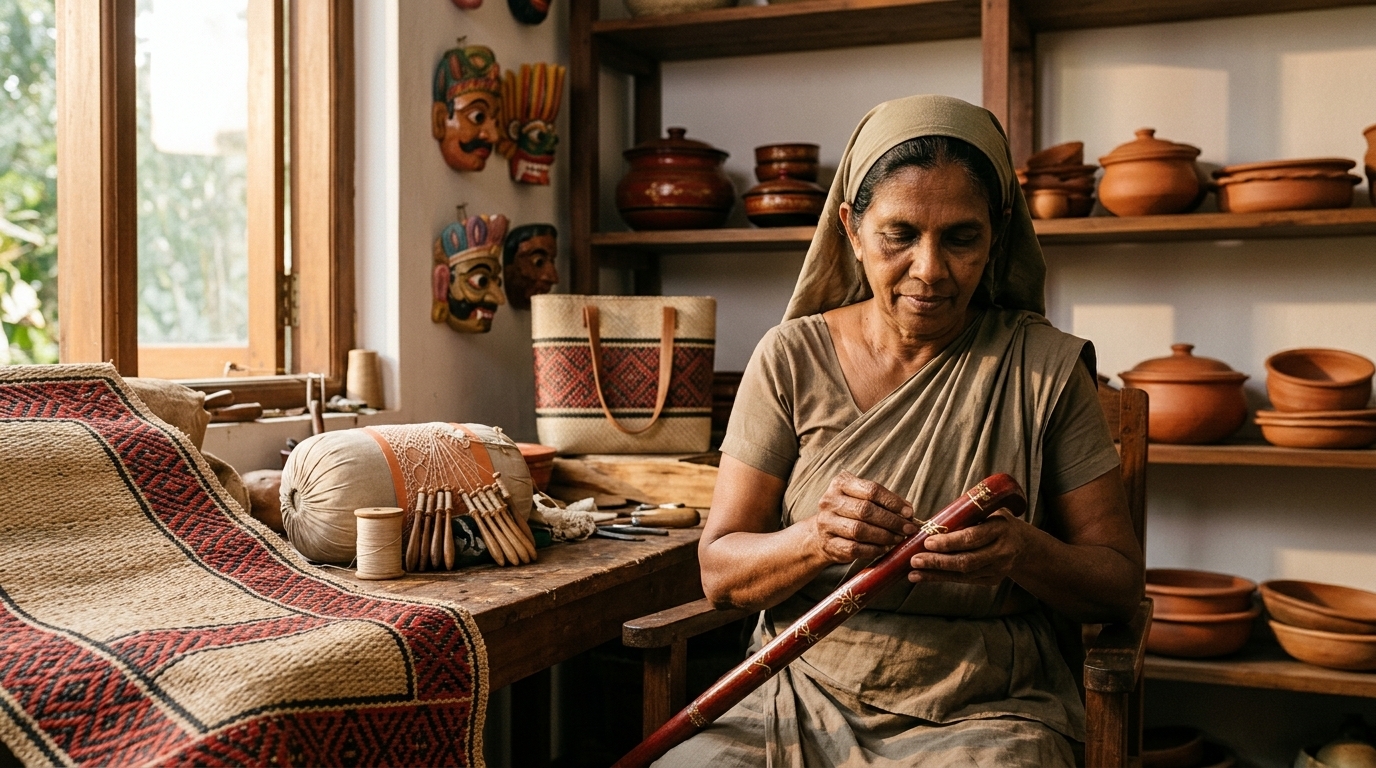
Sri Lanka is famous for tea, beaches, temples and ancient ruins. But some of the island’s most remarkable treasures are much smaller—and they can disappear quietly.
They are found in the hands of craftspeople.
A woven mat made from natural fibre. A lace pattern created thread by thread. A wooden mask carved with a face that seems to carry an entire legend. A piece of lacquerware shaped using techniques passed from one generation to another.
These are not simply “old-fashioned handicrafts.” They are pieces of Sri Lanka’s living cultural memory.
UNESCO currently lists three Sri Lankan elements on its Representative List of Intangible Cultural Heritage: Dumbara Ratā Kalāla, traditional string-puppet drama (Rūkada Nātya), and, most recently, Kithul Madeema/Kithul Kapeema, the traditional technology of tapping kithul palms.
But recognition alone cannot guarantee survival. A craft needs skilled makers, interested younger generations, sustainable materials and, perhaps most importantly, people willing to buy and use the finished products.
Here are five Sri Lankan crafts that deserve a serious comeback.
1. Dumbara Mats — Turning Plant Fibre Into Art
Few traditional Sri Lankan crafts demonstrate patience and precision quite like Dumbara Ratā Kalāla, commonly known as Dumbara mats.
Traditionally associated with the Kinnara community and villages including Kalasirigama and Alokagama, these mats are made using fibres from the hana plant. The fibres are separated, washed, dried, combed and dyed, before being woven into intricate designs using a traditional loom.
The designs are more than decoration. Geometric patterns and symbolic motifs connect the finished object to Sri Lanka's cultural history.
In 2021, UNESCO inscribed the traditional craftsmanship of making Dumbara Ratā Kalāla on its Representative List of the Intangible Cultural Heritage of Humanity. UNESCO also highlighted the importance of transmitting the skill from parents to children.
Why does it deserve a comeback?
Because the craft already fits modern interiors surprisingly well.
Imagine a contemporary apartment featuring a handmade Dumbara wall panel instead of mass-produced wall art—or a boutique hotel using traditional woven pieces as statement décor.
The future of this craft does not have to mean returning to the past. It could mean bringing the past into modern design.
2. Beeralu Lace — The Beauty of Handmade Detail
Before mass-produced textiles made intricate decorative work cheap and easily available, lace-making demanded time, concentration and extraordinary manual skill.
Beeralu lace, particularly associated with southern Sri Lanka, is one example.
Sri Lanka Tourism notes that the craft has a strong tradition in the south and that artisans around places such as Galle have produced intricate lace using the Beeralu technique. National Craft Council training centres have also supported lace-making in the region.
The problem is obvious: handmade lace has difficulty competing with factory-made alternatives when consumers compare products purely by price.
But perhaps price should not be the only comparison.
A handmade lace piece represents hours of human work. It can be incorporated into modern fashion, table settings, wedding décor, interior design, accessories and premium gift products.
The opportunity is to stop treating Beeralu lace as something that belongs only in a museum or traditional household.
It can be heritage and contemporary design at the same time.
3. Ambalangoda Mask Carving — More Than a Souvenir
Mention Sri Lankan traditional masks and many people immediately think of colourful wooden faces from Ambalangoda.
But there is much more to them than their striking appearance.
Traditional Sri Lankan masks are connected with performance traditions including Kolam, Raksha and Sanni. Different masks historically served different cultural and ritual roles.
Ambalangoda remains one of the country's best-known centres for this tradition, with families continuing to practise mask carving and related performance traditions.
Yet the craft faces a difficult question: What happens when the cultural performance surrounding a craft becomes less common, while the object survives mainly as a tourist product?
A recent 2026 report on Sri Lankan mask making highlighted precisely this concern, describing the tradition as increasingly dependent on tourism rather than the rituals and cultural contexts that once gave it meaning.
A comeback should therefore be about more than selling masks.
Schools could teach the stories behind them. Museums could demonstrate the carving process. Designers could collaborate with master carvers. Cultural centres could document traditional techniques digitally.
The mask should not become merely something hanging on a hotel wall.
It should remain connected to the story that created it.
4. Traditional Lacquerwork — An Old Technique With Modern Potential
Sri Lankan lacquerwork is another craft that deserves greater attention.
Traditional lacquer techniques can produce striking decorative objects, with carefully applied colour and patterns transforming relatively simple wooden forms into distinctive pieces.
The challenge is familiar: handmade objects take time, while modern consumers are surrounded by inexpensive factory-made alternatives.
But that is exactly why traditional lacquerwork could work in today's premium design market.
Instead of trying to compete with mass production, artisans can compete on what machines cannot easily reproduce:
- Handmade character
- Cultural identity
- Craftsmanship
- Limited-edition designs
- Personal stories
- Sustainable, locally connected production
A modern Sri Lankan home could feature a contemporary lacquer bowl, lamp base, jewellery box or decorative object inspired by traditional techniques.
The goal should not be to copy an antique.
The goal should be to make something new using an old skill.
5. Traditional Pottery — The Everyday Craft We Almost Stopped Seeing
Pottery may be one of the easiest traditional crafts to overlook because clay objects have always been part of everyday life.
But Sri Lanka has a long pottery tradition, with techniques and forms connected to centuries of local history. Sri Lanka Tourism describes pottery as having an unbroken tradition extending back to the protohistoric period.
Today, however, many everyday household objects have been replaced by plastic, metal and mass-produced ceramics.
That does not mean pottery has become irrelevant.
In fact, the opposite may be true.
As consumers become more interested in natural materials, handmade interiors and products with a sense of place, traditional pottery has an opportunity to return in a completely different form.
Think handcrafted coffee cups, rice bowls, plant pots, serving dishes, lamps and minimalist tableware—made locally and designed for modern homes.
The clay does not need to change.
The way we present it can.
Why Are These Crafts At Risk?
The biggest threat is not necessarily that people have stopped appreciating beauty.
It is that the economic and social system needed to sustain traditional craftsmanship can weaken.
A young person may admire a traditional craft but still choose another career if learning the craft takes years and provides uncertain income.
An artisan may know how to make something extraordinary but struggle to reach customers beyond a small local market.
And consumers may love traditional products but hesitate when handmade prices are compared with factory-made alternatives.
This is why preserving crafts cannot mean simply telling young people to “protect tradition.”
There must be a viable future attached to that tradition.
How Can Sri Lankan Crafts Make a Real Comeback?
The answer may be surprisingly modern.
1. Design for today's homes
Traditional techniques can be used to create contemporary furniture, lighting, fashion, accessories and home décor.
2. Tell the story
People are more likely to value a handmade object when they understand who made it, how it was produced and why the technique matters.
3. Make artisans visible
Instead of presenting crafts as anonymous souvenirs, brands and cultural organisations can introduce the actual craftspeople behind them.
4. Use digital platforms
A skilled craftsperson in a rural village should not be limited to customers who happen to pass through the area.
Photography, social media, websites and e-commerce can connect traditional makers with customers around Sri Lanka and overseas.
5. Teach the next generation
Workshops, apprenticeships, school programmes and collaborations with designers can help turn traditional skills into something young people can see as a future—not merely a responsibility.
6. Avoid turning heritage into a cheap imitation
UNESCO itself has highlighted the need to consider the risks of over-commercialisation in safeguarding Dumbara mat-making.
A craft survives best when commercial success strengthens the community that owns and practises it—not when the cultural meaning is stripped away for mass production.
The Comeback Should Not Look Like the Past
Perhaps the most important lesson is this:
Saving traditional crafts does not mean freezing them in time.
Sri Lankan craftsmanship has survived because people adapted skills to the needs of their communities.
The next chapter can be the same.
A Dumbara pattern can become contemporary wall art. Beeralu lace can appear in modern fashion. Traditional masks can inspire new cultural education and design. Lacquerwork can enter modern interiors. Pottery can return to everyday kitchens and cafés.
And the craftsperson can become more than a maker.
They can become a designer, entrepreneur, teacher, cultural storyteller and guardian of knowledge.
A Small Choice That Can Make a Big Difference
The next time you buy something for your home, a gift for a friend or a souvenir from a trip around Sri Lanka, pause before choosing the cheapest mass-produced option.
Ask one simple question:
“Can I buy something made by a Sri Lankan craftsperson instead?”
That choice may seem small.
But when thousands of people make it, an old craft can become a living industry again.
Sri Lanka does not need to rediscover these crafts.
We simply need to start seeing their value again.
And perhaps the most beautiful comeback story would be one where the skills our grandparents once took for granted become something the next generation is proud to learn.
