


The Environmental Problems Hiding in Sri Lanka’s Villages — And Why They Matter to Everyone
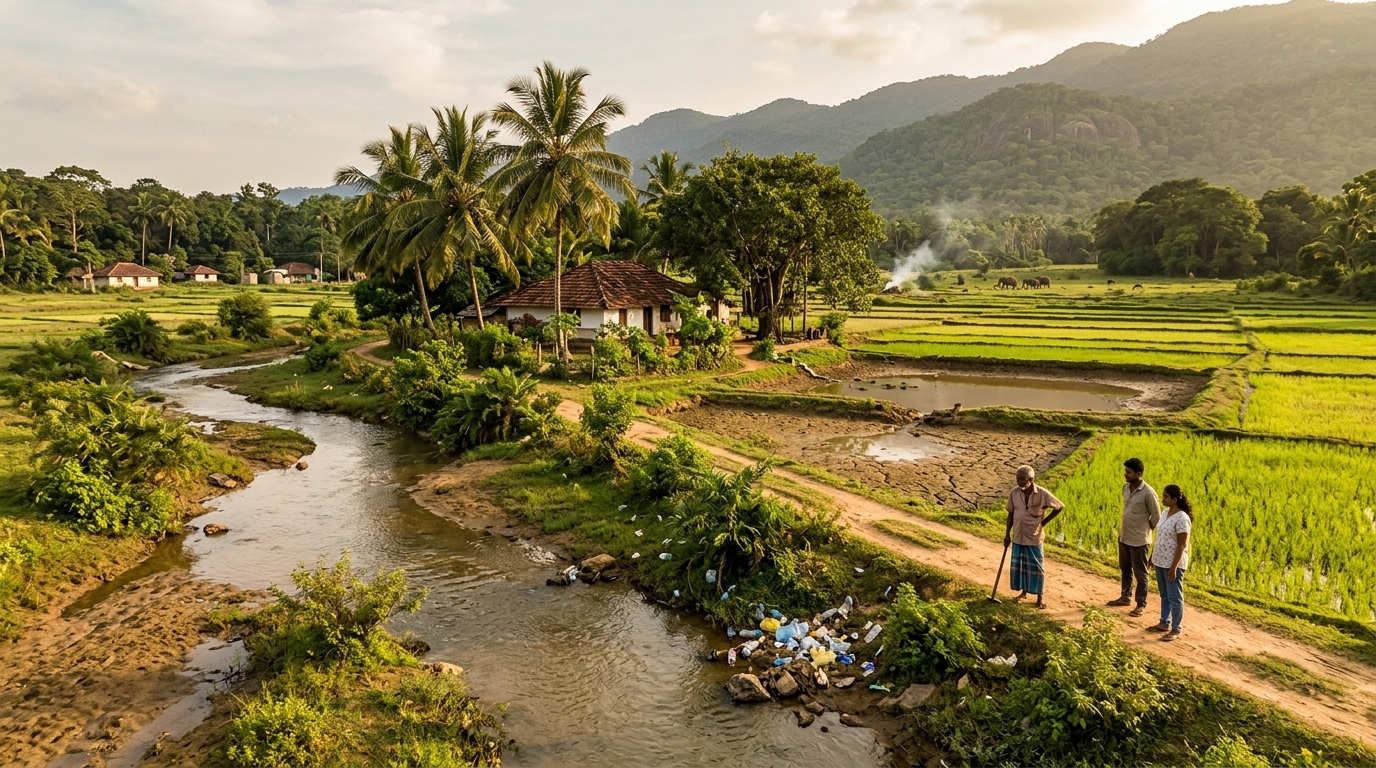
A village can look perfectly healthy from the outside: green paddy fields, a cool stream, coconut trees, home gardens and forests in the distance.
But sometimes the biggest environmental problems are the ones you cannot see immediately.
A well slowly running dry. A stream becoming polluted. Plastic being burned behind a house. A forest edge disappearing one small plot at a time. Farmers losing crops to extreme weather or wildlife. These issues may begin locally, but their consequences can spread far beyond one village.
And in 2026, some of these problems are becoming harder to ignore.
1. Water Is Becoming a Village-Level Crisis
For many rural families, a well, stream, tank or small irrigation system is more than a water source — it is part of everyday life and the local economy.
Sri Lanka is currently experiencing severe drought conditions linked to an El Niño event. Recent reporting from farming areas including Ampara and Monaragala described dried wells, rivers and tanks, major agricultural losses and communities waiting extended periods for water deliveries.
This creates a chain reaction:
Less water → fewer crops → lower income → higher food pressure → greater household vulnerability.
The lesson is simple: protecting village water sources is not only an environmental issue. It is an economic and food-security issue.
What communities can do
- Protect vegetation around streams and water sources.
- Avoid dumping waste into canals and waterways.
- Maintain traditional tanks and drainage systems.
- Use water more efficiently during dry periods.
- Report serious water pollution rather than ignoring it.
2. Plastic Waste Doesn't Disappear — It Moves
A plastic bottle thrown beside a rural road may eventually end up in a drain.
The drain can carry it into a stream.
The stream can carry it into a river.
And the river can carry it toward the sea.
This is why village waste management matters even when the nearest coastline is many kilometres away.
Sri Lanka's Central Environmental Authority identifies solid-waste management as an important environmental responsibility and operates dedicated programmes dealing with waste management. It also prohibits the open burning of plastic waste under relevant regulations.
For households, one of the simplest improvements is to separate waste at the source:
Organic waste | Recyclables | Other waste
Food scraps can often be composted. Clean recyclable materials can be separated. The amount requiring final disposal can therefore be reduced.
3. Burning Garbage Is Still a Hidden Pollution Problem
In some rural areas, burning household waste may seem like the easiest solution.
But smoke doesn't make the waste disappear safely.
Open burning can release pollutants into the air, while plastic and other synthetic materials can create particularly harmful emissions.
The CEA specifically identifies outdoor burning of plastic waste as a prohibited activity under Sri Lankan environmental regulations.
Instead of asking:
“How can I get rid of this waste?”
a better question is:
“How can I prevent this waste from becoming a problem in the first place?”
Reducing unnecessary packaging, separating recyclable materials and composting organic waste are much better starting points.
4. Small Streams Can Become Pollution Hotspots
A beautiful village stream may look clean from the surface while still being affected by wastewater, agricultural runoff or other pollutants.
The CEA maintains water-quality monitoring programmes for major inland surface waters to evaluate pollution and track changes in water quality.
For villagers, warning signs can include:
- Unusual colour or smell
- Dead fish or aquatic animals
- Excessive algae growth
- Waste accumulating along the banks
- Wastewater entering the stream
- Sudden changes after heavy rain
The important point is not to assume that a stream is safe simply because it looks natural.
5. Agricultural Land Is Under Pressure
Sri Lanka's villages are closely connected to farming.
But agriculture depends on several environmental systems working together: healthy soil, reliable rainfall, water availability, pollinators, vegetation and stable ecosystems.
When one of these becomes weaker, farmers can feel the impact directly.
The current drought is a powerful example. Recent reports from rural agricultural communities show how extreme water shortages can reduce harvests and force farmers to search for alternative income.
This makes practices such as soil conservation, efficient irrigation, crop diversification and protecting natural vegetation increasingly important.
6. Human-Wildlife Conflict Is Also an Environmental Problem
When forests, agricultural land and human settlements increasingly overlap, wildlife encounters can become a serious problem.
In March 2026, Sri Lanka's Cabinet addressed crop and livelihood damage caused by wild animals including elephants, wild boar, monkeys, toque macaques, giant squirrels and peacocks.
More recently, Sri Lanka's Parliament called for an urgent national policy addressing human-elephant conflict, while also highlighting the importance of wildlife food and water requirements, ecosystem protection and community participation.
This is important because the solution cannot simply be about protecting crops or protecting wildlife separately.
The bigger question is:
How can villages, farms and wildlife habitats coexist with less conflict?
That requires better land-use planning, community involvement, habitat protection and practical solutions for farmers.
7. Forest Loss Doesn't Always Look Like Deforestation
Environmental damage doesn't always happen through one dramatic event.
Sometimes it happens gradually.
One small area is cleared.
Another becomes a house.
Another becomes a road.
Another becomes farmland.
Eventually, a wildlife corridor is fragmented and a once-connected ecosystem becomes a collection of isolated patches.
For a village, forests provide much more than scenery. They can help regulate water, protect soil, support biodiversity and provide important ecological services.
Protecting remaining natural vegetation can therefore be one of the most valuable long-term investments a community makes.
8. Development Can Create New Environmental Pressure
A new road, house, workshop, hotel or small industry can bring valuable economic opportunities.
But development without environmental planning can create problems involving wastewater, noise, dust, waste, drainage and land-use changes.
Sri Lanka's CEA has environmental requirements covering issues such as wastewater discharge, air emissions, noise and waste management. Certain activities also require environmental approvals or recommendations depending on their nature and location.
The goal should not be:
“No development.”
It should be:
“Better development.”
A village can grow economically without sacrificing the natural systems that make the area liveable.
9. The Problem Is Often Bigger Than One Household
One family throwing rubbish into a stream may seem insignificant.
One person cutting a tree may seem insignificant.
One farmer using too much water may seem insignificant.
But environmental damage becomes serious when thousands of small actions accumulate.
The same principle works in reverse.
One household separates waste.
Another starts composting.
A school protects a small wetland.
Farmers restore vegetation around a water source.
A village organises a clean-up.
A local authority improves waste collection.
Small actions become powerful when they happen together.
What Can a Village Actually Do?
Environmental protection does not always require expensive technology.
A village can begin with practical steps:
1. Map local environmental risks
Identify polluted waterways, illegal dumping areas, vulnerable forests, erosion zones, blocked drainage channels and important water sources.
2. Protect water first
Keep waste, chemicals and untreated wastewater away from wells, streams, tanks and canals.
3. Reduce burning
Create better household waste-separation and collection habits instead of relying on open burning.
4. Protect natural vegetation
Do not remove trees and vegetation unnecessarily around streams, slopes and wildlife habitats.
5. Work with local authorities
Environmental problems are easier to solve when residents, local authorities and relevant government agencies communicate.
6. Teach children early
Environmental awareness becomes much more powerful when it starts at school and continues at home.
7. Report serious environmental problems
Sri Lanka's Central Environmental Authority accepts public environmental complaints through its complaint-management system, while some issues are handled by local authorities or other specialised agencies.
The Future of Sri Lanka's Villages Depends on What We Protect Today
Sri Lanka's villages are often imagined as places of clean air, forests, paddy fields, streams and peaceful landscapes.
But that image cannot survive automatically.
Water scarcity, waste, pollution, land-use pressure, extreme weather and human-wildlife conflict are real challenges. Some are already affecting rural communities directly.
The good news is that environmental protection does not have to begin with a massive national project.
It can begin with one stream.
One well.
One forest edge.
One farmer.
One school.
One household.
Because the environment of a village is not separate from the lives of the people who live there.
Protect the village environment today, and you are protecting water, food, livelihoods and the future of the next generation.
