


The Ancient Dances Sri Lanka Still Performs: Rituals That Refuse to Disappear
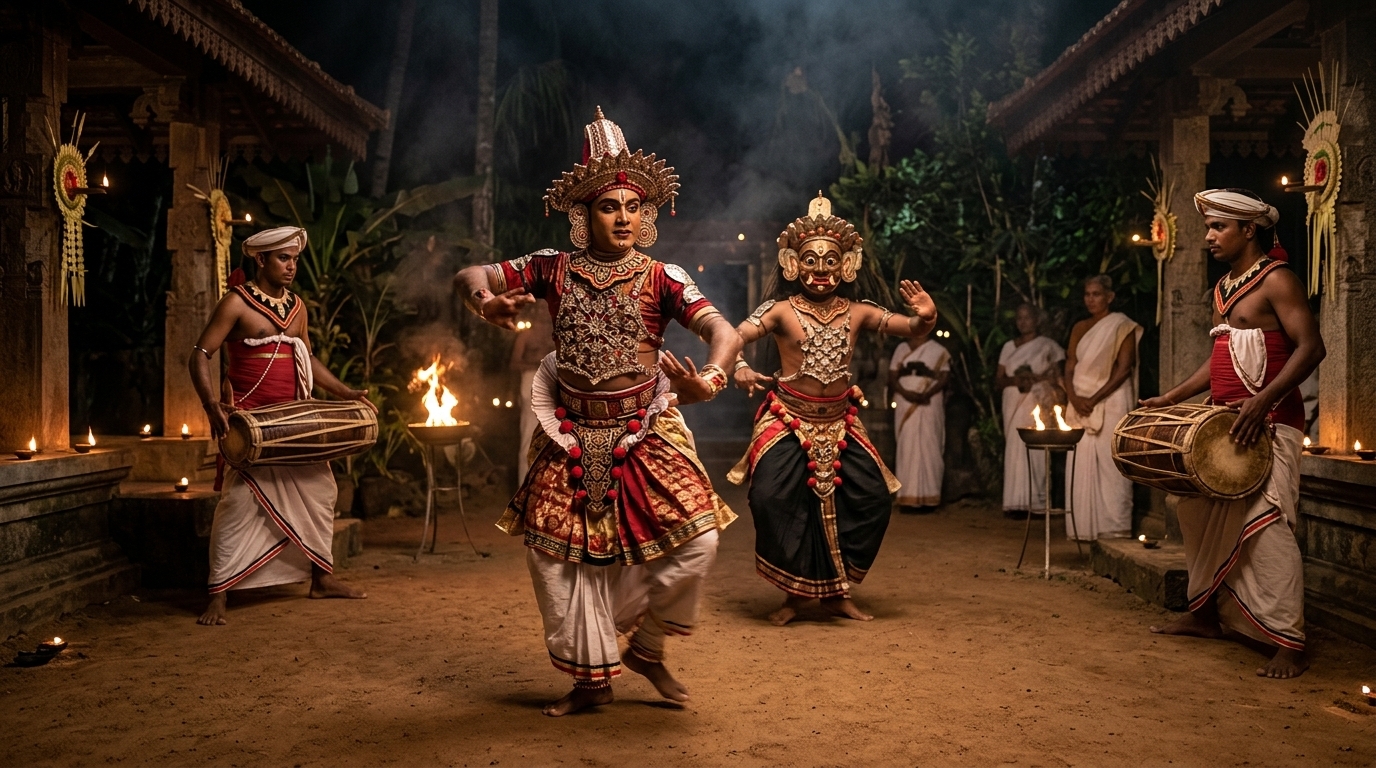
Imagine standing in a Sri Lankan village at night.
The lights are low. A drum begins to beat.
Then another.
Dancers enter wearing elaborate costumes and masks. The rhythm becomes faster, movements become more dramatic, and suddenly what looked like a performance begins to feel like something much older.
This isn't simply entertainment.
Across Sri Lanka, traditional dance remains connected to ritual, blessing, religious observance, folklore and community life. The country's Kandyan, Low Country and Sabaragamuwa traditions continue to be performed today, both within communities and on cultural stages.
And in 2026, these traditions are still being actively presented and promoted. In August 2026, for example, the Kandy Esala Perahera brought traditional dancers, drummers and ceremonial performers into the streets of Kandy, while Sri Lankan cultural performances were also showcased internationally.
So what exactly are these ancient traditions—and why have they survived?
1. Kohomba Kankariya — The Ritual Behind Kandyan Dance
When people think about Sri Lankan traditional dance, they often picture the spectacular movements and costumes of Kandyan dancing.
But behind the stage performance is a much deeper ritual tradition.
Kohomba Kankariya is a traditional healing and ritual ceremony associated with the Kandyan cultural region. It historically involved elaborate sequences of dance, drumming, offerings and ritual actions intended to invoke protection and wellbeing.
Modern stage performances of Kandyan dance often present selected movements and costumes without reproducing the complete ritual context.
That distinction matters.
A dance performed on a stage for an audience isn't necessarily the same thing as a ritual performed within its traditional cultural setting.
2. Sanni Yakuma — When Dance Meets Healing Ritual
Perhaps one of Sri Lanka's most visually striking ritual traditions is Sanni Yakuma, also known as Daha Ata Sanniya.
This Low Country ritual tradition features masked figures representing different forms of illness and supernatural affliction.
The masks are often dramatic, colourful and deliberately exaggerated.
But their purpose goes beyond visual spectacle.
Traditionally, the ritual combines dance, drumming, chanting, masks and ritual performance within a healing context.
It provides a fascinating example of how traditional societies used performance as part of their understanding of illness, wellbeing and the unseen world.
For modern audiences, it can be easy to look at the masks and see only theatre.
Understanding the ritual context reveals another layer.
3. Devol Dance — A Living Low Country Tradition
In parts of Sri Lanka's southern and western coastal regions, traditions associated with Devol continue to appear in cultural and ritual contexts.
The Central Province Tourism Department notes that Devol dance is associated particularly with areas including Matara, Galle, Tangalle, Bentota and Kalutara, and describes it as a tradition connected with homage to Devol and the seeking of protection and assistance.
The performance combines movement, rhythm and traditional verses.
It is a reminder that Sri Lankan dance traditions are not uniform across the island.
Different regions developed their own drums, costumes, movements, stories and ritual purposes.
4. Fire Dance and Fire Walking
Fire introduces an entirely different dimension to Sri Lankan ritual performance.
Traditional fire-walking and fire-related performances can be associated with devotional practices connected to Kataragama and other religious traditions.
The Central Province Tourism Department describes Ginisisila as a traditional fire-related dance/performance connected with homage to Kataragama and the seeking of blessings.
Watching someone walk across glowing embers can look almost impossible.
But within its traditional setting, it isn't simply a demonstration of physical bravery.
It is connected to faith, devotion, ritual preparation and community belief.
5. Gajaga Wannama — When a Dance Becomes an Elephant
Not every traditional dance is a healing ritual.
Some preserve stories and symbolic movements through highly structured choreography.
Gajaga Wannama, one of the famous Kandyan wannam traditions, imitates the movements of an elephant.
The Central Province Tourism Department explains that the dance's movements are based on the walking style of the elephant associated with the procession carrying the Sacred Tooth Relic casket.
Watch carefully and you begin to notice something interesting.
Traditional dance isn't just about moving beautifully.
The body is being used to communicate an idea.
An animal.
A story.
A religious symbol.
A cultural memory.
6. Naga Gurulu — The Battle Between Snake and Bird
The Naga Gurulu tradition brings together two powerful symbolic creatures: the cobra and the mythical Garuda-like bird.
The Central Province Tourism Department connects the Naga concept with Buddhist stories and describes Gurulu as a special bird associated in traditional narratives with the Himalayas and the cobra.
The result is one of the more visually dramatic forms of traditional dance.
The dancer's movements communicate a relationship between opposing forces.
Snake.
Bird.
Movement.
Power.
Protection.
What looks like choreography can therefore also function as visual storytelling.
7. The Drums Are Part of the Story
You cannot understand Sri Lankan ritual dance by looking only at the dancers.
Listen to the drums.
Different traditions use different instruments.
The Geta Bera is strongly associated with Kandyan dance.
The Yak Bera is associated with Low Country dance.
The Davula is used in Sabaragamuwa traditions.
The Central Province Tourism Department notes differences in their shapes and playing techniques.
The rhythm isn't background music.
It helps control movement, establish atmosphere and create the structure of the performance.
In many traditional settings, the sound of the drum is part of the ritual itself.
Why Do These Traditions Still Matter?
It is easy to describe traditional dance as something “from the past.”
That description misses the point.
The Department of Cultural Affairs explicitly treats intangible cultural heritage as including practices, expressions, knowledge, skills, instruments, objects and cultural spaces that communities recognise as part of their heritage. It also identifies traditional arts, crafts, music and related skills as important elements of Sri Lanka's intangible culture.
That means a dance tradition isn't preserved simply because someone keeps an old costume.
It survives when people continue to learn the movements, play the instruments, understand the stories and pass the knowledge to another generation.
Sri Lanka's Department of Cultural Affairs also organises a State Dance Festival with the stated aim of helping preserve dance traditions and pass them to future generations.
Ancient Doesn't Mean Frozen
There is an important misconception about traditional culture.
People sometimes assume that preserving tradition means performing it exactly as it was centuries ago in every situation.
Real cultural traditions are more complicated.
Some forms remain connected to ritual contexts.
Others are taught in dance schools.
Some appear on cultural stages.
Others are presented internationally as part of Sri Lanka's cultural identity.
In June 2026, for example, Sri Lanka's Embassy in South Korea presented a programme combining traditional Kandyan and Low Country dance traditions with contemporary performance, including a fusion element involving K-pop.
That doesn't automatically mean the traditional forms are disappearing.
It shows how cultural traditions can enter new environments while continuing to carry recognizable elements of their heritage.
How to Watch Traditional Dance Respectfully
If you're lucky enough to encounter a genuine ritual rather than a tourist performance, remember that you're entering someone else's cultural and spiritual space.
A few simple rules make a difference.
Don't treat rituals as entertainment alone
Learn what you're watching.
Ask questions respectfully when appropriate.
Don't interrupt the performers
Avoid walking into ritual spaces simply to get a better photograph.
Ask before photographing people
Especially during ceremonies where religious or spiritual practices are involved.
Understand the difference between a show and a ritual
A hotel performance designed for tourists and a community ritual may use similar costumes or movements while having completely different purposes.
Support the people keeping the tradition alive
Attending legitimate performances, learning from trained practitioners and purchasing authentic cultural products can help create continued interest in traditional arts.
The Future of Sri Lankan Dance Depends on People
A tradition cannot survive on nostalgia.
It needs practitioners.
It needs teachers.
It needs students.
It needs audiences who care.
And it needs opportunities for talented young people to continue learning.
That is why the future of Sri Lankan traditional dance isn't only about preserving old choreography.
It's about making sure the knowledge surrounding that choreography remains alive.
The drum rhythm.
The costume.
The mask.
The story.
The movement.
The ritual.
The meaning.
Listen to the Drum Before You Watch the Dance
The next time you see a Sri Lankan traditional dancer perform, look beyond the costume.
Ask yourself:
Why is that movement being performed?
What does the mask represent?
Why is that particular drum being used?
Is this a stage performance, a religious ceremony, or part of a ritual tradition?
Those questions can transform a beautiful performance into something much more meaningful.
Because Sri Lankan traditional dance isn't simply a collection of impressive movements.
It is a living record of how communities expressed belief, identity, storytelling, devotion and hope through the human body.
And perhaps that is why these ancient rhythms are still being heard today.
The dancers change. The stages change. The audience changes. But when the drum begins and the movement starts, a piece of Sri Lanka's cultural memory comes alive again.
