


The Hidden World of Dumbara Weaving: How Sri Lankan Hands Turn Simple Fibre Into Living Art
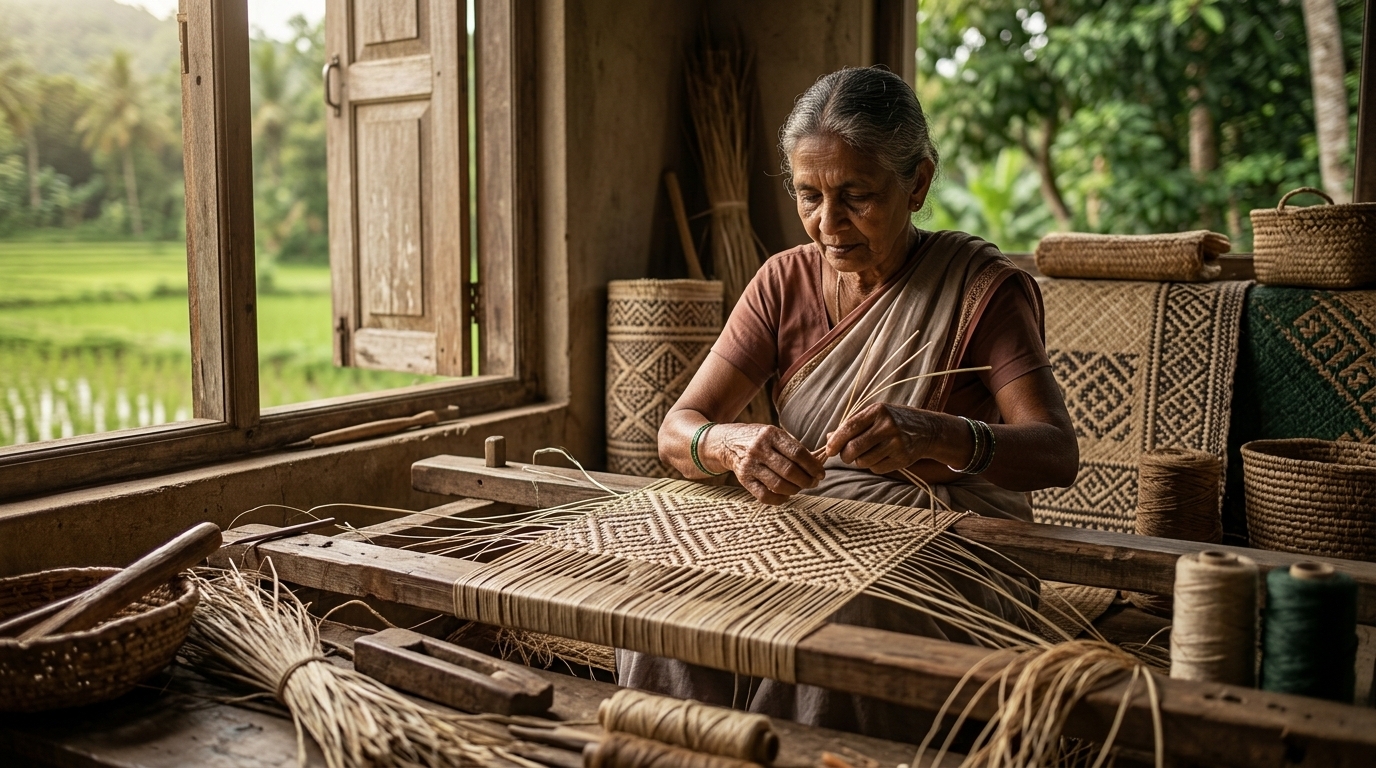
What if a piece of woven fabric could tell you where it came from, who made it, and how generations of Sri Lankan craftsmanship survived into the modern world?
That is the story behind Dumbara weaving.
Known in Sinhala as Dumbara Rata, this traditional craft is associated particularly with the Dumbara region around Kandy and Matale. What may look like a simple woven mat or wall hanging is actually the result of carefully prepared natural fibre, patient handwork and patterns carrying cultural meaning.
And in an age of mass-produced decoration, that makes Dumbara weaving remarkably relevant.
What Exactly Is Dumbara Weaving?
Dumbara weaving is a traditional Sri Lankan craft in which artisans create woven products from natural plant fibres.
Historically, hana, a fibre obtained from plants such as Agave cantula and related species, has been an important material in the craft. The fibres are processed, twisted and woven by hand to create durable objects.
Traditional Dumbara products include:
- Mats
- Wall hangings
- Baskets
- Containers
- Bags
- Decorative panels
- Household items
The finished pieces often feature geometric patterns, stylised animals, plants and other traditional motifs.
The beauty comes from an unusual combination:
Simple materials + skilled hands + meaningful design.
The Material Has a Story Too
Before the weaving begins, the raw material must be prepared.
The plant fibre is separated, cleaned, dried and processed so that it can be used for weaving.
This isn't simply a mechanical process.
The artisan needs to understand the material—its strength, flexibility and behaviour during weaving.
The preparation affects the final product.
If the fibre isn't properly processed, the finished object won't have the same strength or appearance.
So when you look at a completed Dumbara weaving, you're not seeing only the final stage.
You're seeing the result of a long chain of traditional knowledge.
Why Are the Patterns So Interesting?
One of the most recognisable features of Dumbara weaving is its geometric visual language.
Triangles, diamonds, lines and repeated forms can be combined into complex patterns.
Traditional motifs may also represent elements from the natural and cultural environment.
Animals, birds, flowers and other forms can be simplified into patterns that are repeated through the weave.
This creates an interesting visual effect.
From a distance, the object may appear to be a simple geometric design.
Look closer, and you begin to notice the individual motifs.
Look even closer, and you see the individual fibres and the handwork behind them.
It Is Functional Art
Dumbara weaving wasn't created simply to sit inside a museum.
Traditional weaving developed around objects that could be used in everyday life.
Mats could serve practical household purposes.
Baskets and containers could help with storage.
Other woven objects could become decorative or ceremonial pieces.
This combination of usefulness and beauty is one of the most fascinating characteristics of traditional craft.
The artisan isn't asking:
“How can I make something that looks beautiful?”
They are solving a practical problem while creating something visually meaningful.
Every Pattern Takes Patience
Machine-made products can reproduce identical designs extremely quickly.
Hand weaving is different.
The artisan must maintain the structure of the weave while controlling the placement of individual fibres.
A complicated pattern requires concentration.
One mistake can affect the appearance of the surrounding design.
That is why handmade weaving carries something that mass production cannot easily reproduce:
visible evidence of human effort.
Tiny variations aren't necessarily defects.
They are reminders that a person—not a machine—made the object.
Dumbara Weaving Is Part of Sri Lanka's Intangible Heritage
The importance of Dumbara weaving extends beyond the finished product.
It represents traditional knowledge, skills and cultural practices passed from one generation to another.
Sri Lanka's traditional crafts are increasingly discussed not only as cultural heritage but also in terms of safeguarding artisan livelihoods and keeping traditional skills economically viable.
That distinction matters.
A craft can survive in photographs and museums while the practical knowledge required to make it disappears.
True preservation means keeping the skills, people and communities behind the craft alive.
The Challenge of the Modern World
Traditional artisans face a difficult equation.
A handmade product requires time.
A factory-made imitation can often be produced much faster and sold more cheaply.
Consumers may see two similar-looking objects and naturally choose the cheaper one.
But the comparison isn't always fair.
One product may represent hours of skilled labour and generations of knowledge.
The other may simply reproduce the appearance.
This is why consumers have an important role.
When you deliberately choose authentic handmade craft, you're not just buying an object.
You're helping create a market for the skill behind it.
Why Dumbara Weaving Fits Modern Design
Interestingly, traditional Dumbara patterns don't need to remain trapped in traditional interiors.
Their geometric forms can work beautifully with contemporary design.
Imagine a traditional woven wall panel inside a minimalist apartment.
A natural-fibre basket beside modern furniture.
A handwoven bag paired with contemporary clothing.
A traditional pattern incorporated into modern interior accessories.
The key is not to erase the tradition.
It's to allow traditional techniques and visual language to find new applications.
Heritage doesn't have to mean old-fashioned.
How to Buy Authentic Handmade Craft
If you're interested in purchasing Dumbara weaving, don't judge it only by appearance.
Ask questions.
Who made it?
A reputable seller should be able to explain where the product came from and, where possible, who made it.
What material was used?
Natural fibres and traditional materials can vary in quality.
Understanding the material helps you understand what you're buying.
Is it genuinely handmade?
Some products imitate traditional designs without being produced using traditional techniques.
If authenticity matters to you, ask about the production process.
How should it be cared for?
Natural-fibre products may require protection from excessive moisture, direct sunlight or improper storage.
Good care can significantly extend the useful life of a handmade piece.
Don't Just Buy the Product—Learn the Story
The next time you see a traditional Sri Lankan woven product, pause before asking about the price.
Look at the pattern.
Look at the fibre.
Look at the construction.
Think about the time required to make it.
Then ask where it came from.
That simple curiosity can turn an ordinary shopping experience into a cultural experience.
The Future of Dumbara Weaving
The future of traditional craft doesn't have to be a choice between preserving the past and embracing the future.
It can be both.
Artisans can preserve traditional techniques while creating products that suit contemporary lifestyles.
Designers can collaborate with craft communities without stripping away cultural identity.
Consumers can choose durable handmade products rather than disposable alternatives.
And younger generations can discover that traditional craftsmanship isn't merely something their grandparents did—it can also be a viable creative profession.
The real challenge is making sure innovation doesn't replace the knowledge that makes the craft special.
A Piece of Weaving Is More Than a Decoration
Dumbara weaving reminds us of something modern manufacturing often makes easy to forget:
Objects have stories.
A woven basket can represent knowledge.
A pattern can represent culture.
A natural fibre can represent a relationship with the local environment.
And a handmade object can represent the time and skill of an individual artisan.
So the next time you see a piece of Dumbara weaving, don't see only the finished design.
See the hands behind it.
See the material.
See the generations of knowledge.
Because when traditional craft survives, we don't simply preserve an object—we preserve a way of knowing how to create.
